ChatGPT starts running ads, and OpenAI is betting trust still sells
OpenAI is putting ads into free ChatGPT. The stated reason is subsidizing cost. The real motive is finding revenue from a billion users who will never pay. And it draws itself a line that is very hard to police: answers cannot be quietly steered by ads.
Summary
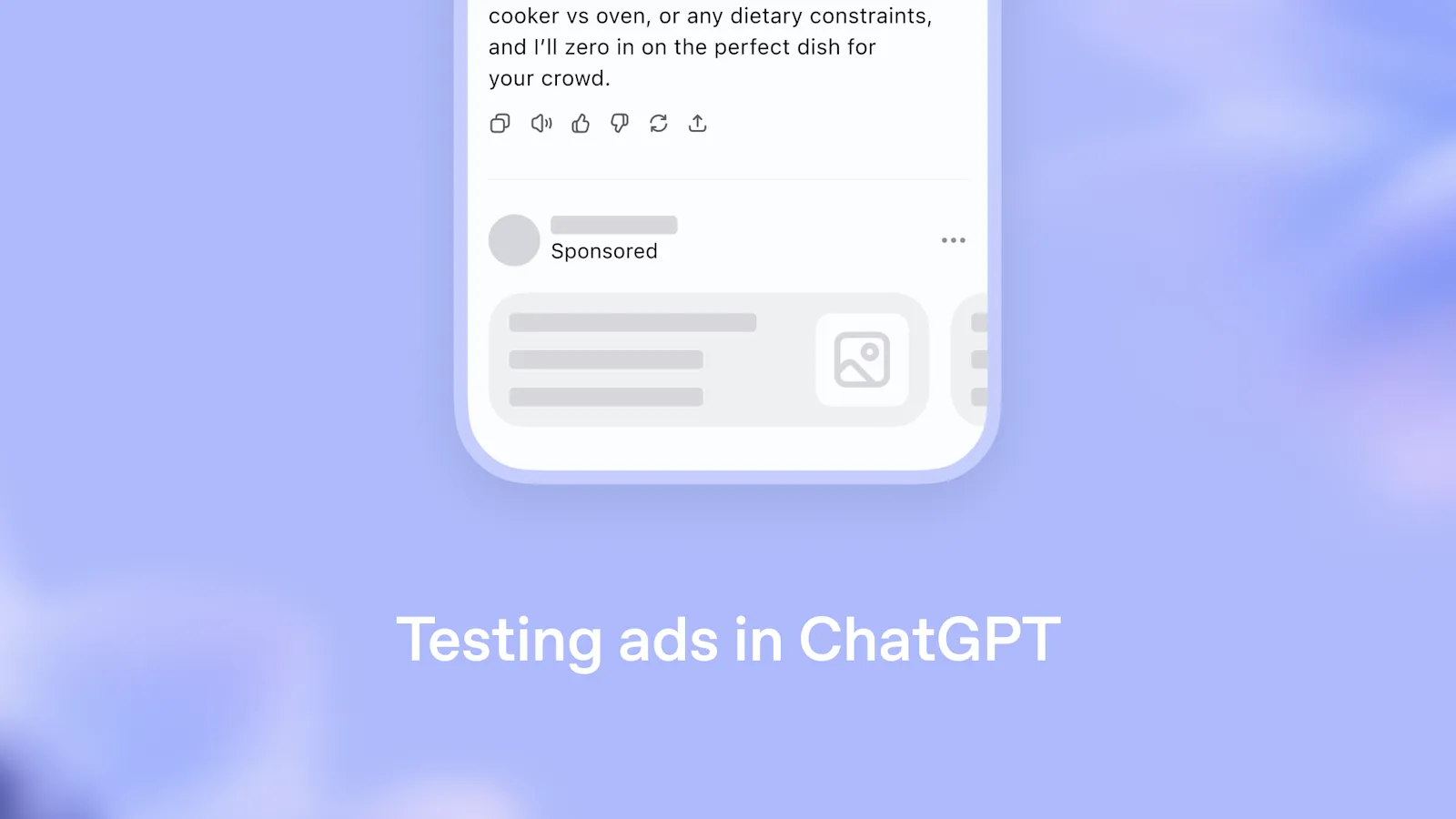
OpenAI has started running ads inside free ChatGPT. The pilot begins with logged-in adult users on the Free and Go tiers in the United States, while Plus, Pro, Business, Enterprise, and Education stay ad-free. It will expand to Canada, Australia, New Zealand, the United Kingdom, Mexico, Brazil, Japan, and South Korea. OpenAI says ads will be clearly labeled, kept separate from organic answers, invisible to advertisers as conversation content, and unable to influence how the model responds.
The weight of this is not in what the ad looks like. It is that OpenAI is now openly admitting it will make money from the attention of users who never pay. A company that built “aligned with human interests” and “not corrupted by commercial goals” into its mission is now inserting the highest bidder’s content into the same box where people ask about their health, their jobs, and their family decisions. This is a business-model shift, and OpenAI has handed itself a red line that is almost impossible to prove it is holding with a screenshot.
The move
The mechanics are restrained. Ads show up as labeled cards beside the answer, never inside it. They are matched against the current topic, past chats, and prior ad interactions. Advertisers get aggregated performance data and never see chat content. Sensitive and regulated categories such as health and politics are excluded. OpenAI also keeps an ad-free free option in place, paid for with lower usage limits.
Read together, these terms describe a deliberately gentle form of advertising. OpenAI wants the cash that ads bring without paying the price a search engine pays, where users simply assume the results are tilted. It is spending a long list of self-imposed constraints to buy an entry ticket for something that arguably has no business being inside an assistant.
The real motive
Subsidizing the compute cost of free users is true, but it is only the half that is comfortable to say out loud. The other half is that OpenAI’s math does not close. It has on the order of a billion free users, every conversation burns inference cost, and subscription conversion has a hard ceiling. A paywall only ever captures the small slice willing to pay. The attention of everyone else has had no path to revenue until now. Ads are the only mechanism that turns free scale itself into income. The substance of the move is OpenAI finally conceding that ChatGPT will walk the same road Google search did: free for everyone, billed to the businesses that want to reach them.
But OpenAI’s version is harder than Google’s was. Users always expected commercial ranking in a search box, whereas ChatGPT sells judgment and advice. The moment a user suspects “it recommended this because it got paid,” the product’s value collapses. So the promises about labeling, answer independence, and advertisers never touching the conversation are not a moral pose. They protect OpenAI’s real asset: the belief that the answer was not bought. The bet is that this trust still sells even after ads are inserted next to it.
Worth noticing is the exclusion of sensitive and regulated topics. It looks like a compliance move, but it is also a commercial calculation. Conversations about health or politics are exactly the moments a user is most vulnerable and most easily influenced. Running ads there might pay in the short term, but it would burn through trust first. By carving that traffic out of monetization on its own initiative, OpenAI signals it understands trust is the principal of this business, not a profit it can dip into whenever convenient.
Who is threatened
Google should be the most nervous. If conversational ads work without wrecking trust, OpenAI will have proven something dangerous: that a several-hundred-billion-dollar search-ad business can be taken over by an interface that answers the question instead of returning ten blue links. A user who asks “which dishwasher fits a small kitchen” and gets a direct answer plus a labeled ad is far closer to a purchase decision, and far more valuable, than a page of search results.
Next are the AI apps living behind subscription walls. Once OpenAI shows that free-plus-ads can sustain a billion users, the pricing logic of the whole field gets rewritten, and pure subscription starts to look both expensive and hard to scale.
Then there are the advertisers themselves. They are used to the control of search advertising, where money buys a better slot. What OpenAI offers is aggregated data, excluded sensitive categories, and no influence over the answer. For advertisers this is a sharply de-powered channel, and whether they accept these terms will decide how big the business actually gets.
Technical takeaway
For OpenAI’s promises to hold, the monetization system has to be architecturally walled off from the generation system. Ad matching, delivery, bidding, measurement, and advertiser reporting must not share a path with the model that produces the answer. The ad system can know what you are talking about, but the model producing the response cannot tilt toward a bidder because of it. Whether that isolation actually exists is invisible from the outside, which is exactly what makes answer independence so hard to earn belief for: it is an architecture problem that users can only take on faith.
The highest-risk part is personalization. Matching an ad to the current thread is already sensitive, and OpenAI also pulls past chats and memory into the matching signal. Those signals can hold a person’s long-lived preferences, the life events they have been through, their relationships, even moments of vulnerability. A defensible system needs controls granular enough to govern those signals on their own, clear retention windows, deletion that genuinely changes ad selection rather than just removing something from the UI, and a rule that ad interactions do not write back into memory unless the user explicitly opts in. None of this is decoration. It is the foundation that decides whether the business can be trusted at all.
What to ignore
Ignore the reflex that any ad in a free product is a sellout. Compute costs are real, keeping a billion people on a free tier requires someone to pay, and ads are not original sin. The thing to watch is not whether ads exist but whether the answer bends because of them.
Ignore the comfort of “ads are labeled and separated from the answer.” Visual separation is the easy part. The hard part to verify is whether retrieval, ranking, the examples cited, and the follow-up suggestions, all of which the user never sees, have been touched by the ad system. A card marked “sponsored” proves nothing about the purity of the answer.
The misreading most worth discarding is drawing conclusions from early numbers. Click-through, dismissal rates, and pilot revenue are noise. The only metric worth waiting for is whether users still trust the answer when an ad sits right next to it, and that takes several quarters and a test of whether OpenAI keeps its promises once the revenue is large enough to tempt it.